Govern every model request
Route across providers, apply app-level guardrails, manage keys and budgets, and trace every production LLM request from one control plane.
Route
Send AI traffic to the right model or provider.Guard
Apply policies before requests leave your system.Observe
Track requests, tokens, costs, errors, and traces.Optimize
Control spend, latency, fallbacks, and provider usage.Connect. Configure. Observe.
Start with a gateway key, define how AI traffic should behave, then watch every request as it moves through your production path.
01
Connect
Bring provider keys, create app credentials, and point your applications to the Agumbe gateway.
02
Configure
Set model routing, guardrails, budgets, environments, and app-level access policies from the console.
03
Observe
Follow every request with usage logs, token counts, cost, latency, errors, and trace-ready telemetry.
More than model access. A safer request path for every app.
Production traffic needs app keys, policies, budgets, request history, and debugging signals in one place.
App-level access
Issue credentials per application, team, or environment instead of scattering provider keys across services.
Provider-neutral routing
Move between external providers, private models, and fallback routes without hardcoding provider logic everywhere.
Guardrails before egress
Check denied topics, sensitive data, and request policy before prompts reach any external model provider.
Budgets and limits
Attach caps to apps, teams, and environments so AI usage stays visible before spend surprises the team.
Request visibility
See who called what, when, from where, which model was used, and how much each request cost.
Trace-ready telemetry
Emit request-level signals into the observability stack your platform team already understands.
Keep the developer API stable while models change underneath.
Let application teams integrate once. Then introduce new providers, local models, fallback policies, app allowlists, and customer-owned keys without rewriting every service.
Provider-compatible clients
Use familiar SDKs by changing the base URL and gateway key.
Multiple model providers
Route to hosted providers, private models, or local checks through aliases.
Bring your own keys
Keep provider accounts behind app-scoped gateway credentials.
Environment-aware routing
Use different policies for development, staging, production, or customer traffic.
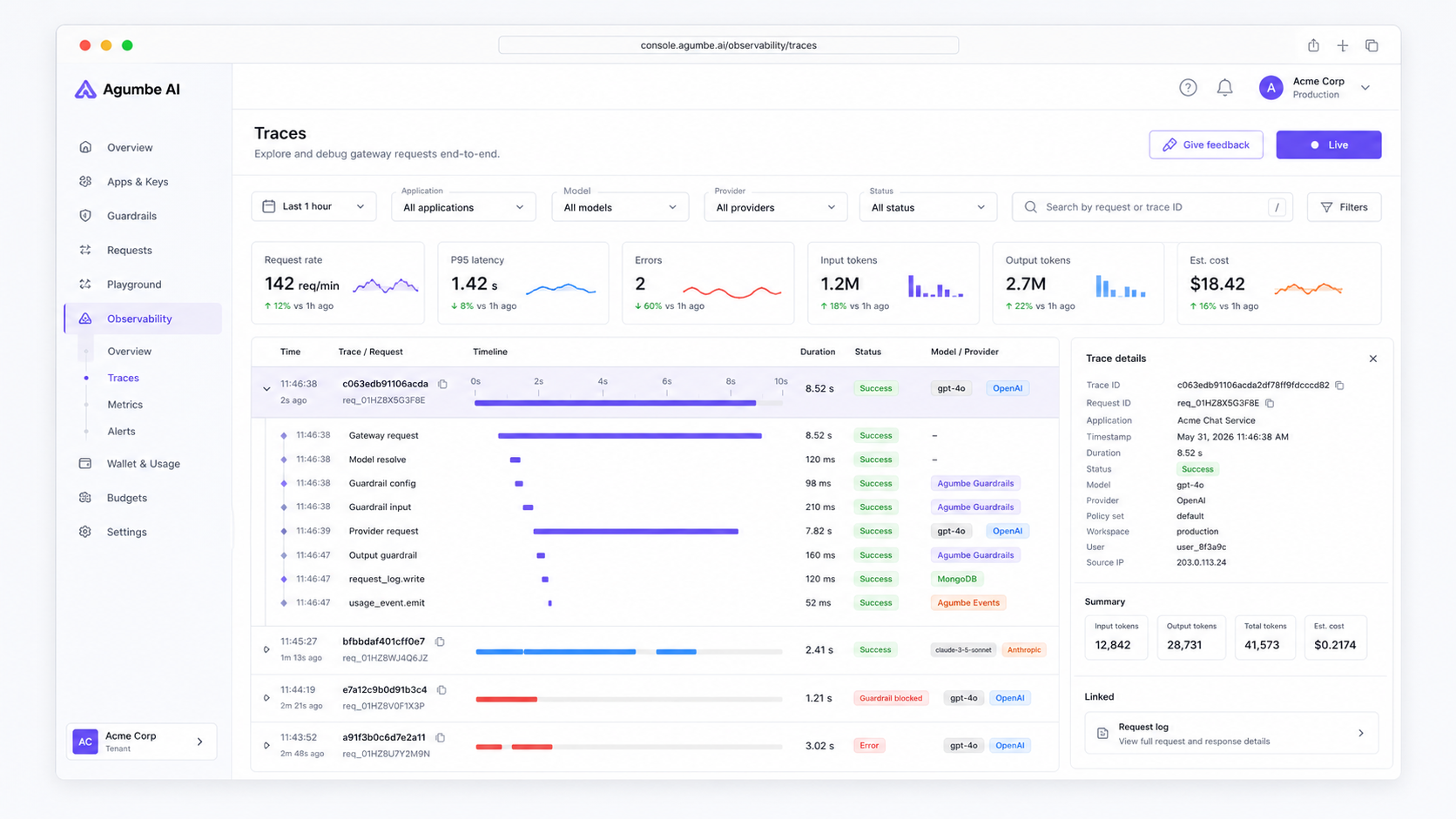
Debug the request, and the model response.
See app identity, policy decisions, provider routing, model latency, token usage, cost, and trace correlation together. When a request fails or gets blocked, the explanation is visible.
Separate provider latency from gateway overhead.
Open guardrail decisions next to the request that triggered them.
Follow aggregate error rates down to one trace and one app key.
Trace waterfall
gateway.request
auth.app_key
guardrails.check
provider.chat
usage.emit
Adopt the gateway with a one-line change.
Point your application, internal tool, agent, or developer workflow to Agumbe. Keep provider choice, guardrails, budgets, and visibility outside application code.
gateway-client.ts
import OpenAI from "openai";

const client = new OpenAI({
  baseURL: "https://api.agumbe.ai/v1",
  apiKey: process.env.AGUMBE_GATEWAY_KEY
});

const response = await client.chat.completions.create({
  model: "agumbe/smart-router",
  messages: [{ role: "user", content: prompt }],
  metadata: {
    app: "support-copilot",
    environment: "production"
  }
});OpenAI Codex and Agumbe AI Gateway
Route Codex requests through Agumbe AI Gateway to unlock guardrails, smart routing, observability, and more.
~/.codex/config.toml
model_provider = "agumbe"

[model_providers.agumbe]
name = "Agumbe Gateway"
base_url = "https://api.agumbe.ai/api/v1/llm"
env_key = "AGUMBE_API_KEY"Anthropic Claude Code and Agumbe AI Gateway
Connect Claude Code to Agumbe with your Agumbe API key. Requests are routed through the gateway with your guardrails, budgets, and observability applied.
~/.claude/settings.json
{
  "env": {
    "ANTHROPIC_BASE_URL":
      "https://api.agumbe.ai/api/v1/anthropic",
    "ANTHROPIC_AUTH_TOKEN": "YOUR_AGUMBE_API_KEY",
    "CLAUDE_CODE_ENABLE_GATEWAY_MODEL_DISCOVERY": "1"
  },
  "model": "claude-sonnet-4-6"
}Google Gemini and Agumbe AI Gateway
Use Gemini models through the same Agumbe API key, routing layer, BYOK controls, budgets, guardrails, and request observability used by your other providers.
Chat Completions API
curl https://api.agumbe.ai/api/v1/llm/chat/completions \
  -H "Authorization: Bearer $AGUMBE_API_KEY" \
  -H "Content-Type: application/json" \
  -d '{
    "model": "@google/gemini-2.5-flash",
    "messages": [
      {
        "role": "user",
        "content": "Summarize this support ticket."
      }
    ],
    "max_tokens": 220
}'FAQs
What is an AI gateway?
Agumbe provides a governed API layer between applications and LLM providers, so teams can route requests, apply policies, observe usage, and control spend centrally.
Does Agumbe support BYOK?
Yes. Teams can bring their own provider keys and manage routing, budgets, guardrails, and observability from one gateway.
Can Agumbe work across multiple LLM providers?
Yes. Agumbe is provider-neutral and is designed to route traffic across supported LLM providers without forcing application teams to wire every provider directly.
What can platform teams observe?
Teams can inspect requests, tokens, costs, latency, errors, provider usage, app-level usage, and traces from the console.
Can Agumbe apply guardrails before prompts leave the system?
Agumbe is designed for gateway-level governance, including app-scoped guardrails and policy checks before requests are routed to providers.
Agumbe LLM Console
Start routing AI traffic through a governed gateway.
Connect your apps, configure routing and guardrails, then observe every request as teams move toward production AI usage.